The Legend of Bing Conglin 冰聪林传奇 (2024) #
The Legend of Bing Conglin 冰聪林传奇, written by Und1c1 and Super Crystal Monkey, illustrated by Super Crystal Monkey, translated by Jiu Song, Xiaohongshu, 2024.1
translation and introduction: 1 March 2026
Introduction to the text #
Jiu Song
This work differs from most of the lianhuanhua translated on this website. Before I begin, I would like to invite readers to reflect on two questions: Is this ongoing work truly a lianhuanhua? Does it offer an inspiration for the future of lianhuanhua?
The Legend of Bing Conglin 冰聪林传奇 is an ongoing contemporary lianhuanhua serialised on Xiaohongshu 小红书 by Super Crystal Monkey. Centered on her original character Bing Conglin 冰聪林, the work is scripted in collaboration with Und1c1 and illustrated by the author herself. Super Crystal Monkey, a pen name, is currently a student of traditional Chinese painting at a fine arts institution in China; this project marks her first online lianhuanhua.
I encountered her ongoing work on Xiaohongshu while searching for Gen Z lianhuanhua readers. When browsing keywords such as “lianhuanhua 连环画,” the series appears prominently in platform recommendations. Since its launch in October 2024, it has maintained high engagement, averaging around 4,000 likes per update, with one post reaching 14,000. The polished and popular story offers a unique perspective on Gen Z fan-made lianhuanhua. Here, “fan-made” refers to an artist who deliberately adopts established lianhuanhua stylistic paradigms for an original narrative rather than a professional lianhuanhua artist exclusively working within the medium. This definition is specific to my own research framework and is not intended as a universal category.
The translated content, told from the perspective of the banished Immortal Maiden Bing Conglin, recounts her childhood prior to her participation in a folk uprising during her first trial in the human world. This xianxia 仙侠 adventure is not rooted in any specific historical period; rather, it is a new story space within a pseudo-historical setting, created by the author by blending her understanding of past dynasties with her own imagination. In the story, Bing Conglin was originally a Forget-Worry Divine Herb 忘忧神草 in the palace of the Immortal Lady Lin 林仙君. Though beautiful, she is mischievous and unruly. Due to a frame-up, she is banished to the Mortal Realm to undergo tribulations. In the mortal world, she experiences a free-spirited childhood full of love and warmth. However, this happy childhood comes to an abrupt halt with the onset of war in the mountain.
As a member of Gen Z, Super Crystal Monkey has her own interpretation of lianhuanhua and appropriation. She utilizes line drawing and black-and-white composition, drawing on the character designs of Japanese manga and Chinese lianhuanhua. She believes a vintage style of lianhuanhua is a suitable way to tell the prequel. In an interview with me on June 13, 2025, she cited the vessel patterns (Panels 4, 5, 9) and compositional structures (Panels 16, 32) of lianhuanhua artists Dai Dunbang 戴敦邦 and Lu Yanguang 卢延光 as direct references (see Figure 1; SJH 2025a). The Japanese manga artist Sumeragi Natsuki 皇なつき, who studied in China and whose work in turn was shaped by lianhuanhua aesthetics, also influenced her work (SJH 2025a). In Panel 10, the Bing family’s former prosperity appears as decorative motifs on the father’s clothing, integrating memory into costume design. In Panel 33, the adult Bing Conglin is depicted nude (with key areas obscured), emphasizing her divine status; mountain clouds surrounding her body simultaneously evoke the flames of war below.
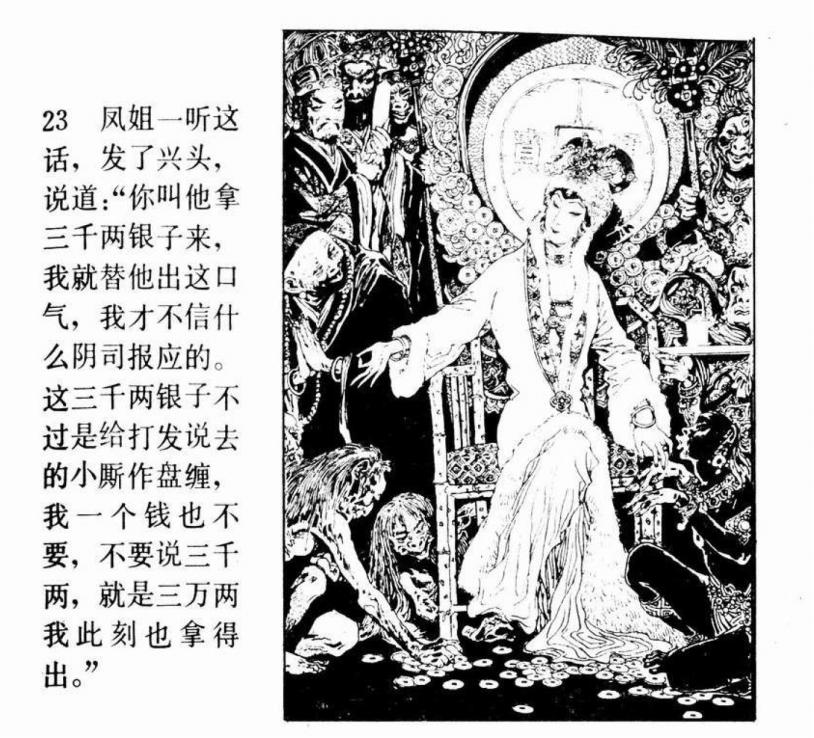 Fig. 1. Dai Dunbang 戴敦邦, illustration from Stories from Dream of the Red Chamber 红楼梦故事 (Beijing: People’s Fine Arts Publishing House, 1985). The vessel ornamentation and decorative motifs exemplify the vintage lianhuanhua aesthetic referenced by Super Crystal Monkey (SJH 2025a).
Super Crystal Monkey states about her conception of the story: “This is a story belonging to my original character; it is the content I personally want to tell. Bing Conglin is not a perfect character. She is unruly, impulsive, and careless; compared to Xia Moli 夏茉莉, she is not good at studying. In the ending I designed, the uprising is destined to fail; imperial power is not so easily defeated. I didn’t want to create an exaggerated happy ending just for the reader’s gratification” (SJH 2025b).
Rather than repeating a traditional or stereotypical “hero saves the beauty” paradigm of the xianxia genre, the creator revolves around a feminist narrative to tell a new story. She believes Bing Conglin does not need to be saved by a male character; she is powerful on her own. This is a modern narrative framed within vintage panels, tracing the growth of an independent girl and her friend.
About the translation #
In preparing this translation, my objective was to present the creator’s intent with clarity and minimal intervention. The original text moves between modern vernacular and Classical Chinese, creating a classical aesthetic that posed particular challenges in translation. On key terms, I consulted the creator herself. As a xianxia 仙侠 narrative, the story draws on both Taoist and Buddhist terminology without strict sectarian distinction. My translation choices therefore follow contextual usage and the creator’s interpretation:
Panel 2: Immortal 仙君 I chose “Immortal” rather than “Celestial” because the narrative framework aligns with Taoist concepts of self-cultivation and cyclical growth.
Panel 2: Attendant 座下童子 In classical mythology, Immortals or Bodhisattvas are accompanied by youthful disciples who assist with daily duties. For example, in Journey to the West 西游记, Red Boy 红孩儿 becomes Guanyin’s attendant (Wu 2010, chap. 42). I selected “attendant” rather than “acolyte” to convey both service and discipleship without overt religious specificity.
Panel 10: Clan 族 and Lineage 一脉 I use “clan” to describe the large, prominent family group sharing the same surname; for the latter half of the sentence mentioning “冰父一脉,” I translated it as “Conglin’s father’s lineage” to specifically refer to the small, direct family unit consisting of her father and grandfather.
Panel 12: Child-Giving Guanyin 送子观音 I retained the functional modifier “Child-Giving” to reflect its devotional role in folk belief and kept “Guanyin” as an established transliteration rather than adopting the Sanskrit form.
Panel 19: Warrior 侠 When describing Madam Bing 冰母, I chose “warrior.” This emphasizes her identity as a highly skilled female martial figure.
Panel 23: Character Descriptions In translating 凤眼 and 黑睛藏威, I adopted accessible phrasing while preserving their poetic quality. 凤眼 denotes both a distinctive upward-tilted eye shape and Bing Conglin’s innate nobility. I therefore rendered 凤眼 as “a pair of phoenix eyes” and translated 黑睛藏威 as “a concise expression conveying the restrained power within her dark gaze”.
Panel 25: The Four Arts 琴棋书画 and Feminine Arts 刺绣女工 These phrases refer to the traditional accomplishments expected of a young woman from an elite family. To retain the concision of the original, I translated them as: “the four arts of the Chinese scholar, but even more so with embroidery and the feminine arts.” In the classical context, The Four Arts 琴棋书画 specifically denote mastery the music instrument guqin, Go, calligraphy, and painting, while Feminine Arts 刺绣女工 refer to traditional women’s handicrafts, particularly embroidery. I use “feminine arts” as a concise collective term to convey this cultural scope.
References #
Dai, Dunbang 戴敦邦, illustrator. 1985. Stories from Dream of the Red Chamber 红楼梦故事. Based on the novel by Cao Xueqin 曹雪芹 and adapted by Wu Qirou 吴启柔. Beijing: People’s Fine Arts Publishing House.
SJH. 2025a. Interview by author. June 13, 2025. Interview transcript/notes.
SJH. 2025b. Interview by author. February 18, 2025. Interview transcript/notes.
Super Crystal Monkey. n.d. Xiaohongshu homepage. Accessed February 24, 2026. https://xhslink.com/m/5hQowJEX25z.
Wu, Cheng’en 吴承恩. 2010. Journey to the West 《西游记》. 3rd ed. Beijing: People’s Literature Publishing House. Originally published 1955.
Read the translated lianhuanhua #
- Front cover
- Page 01
- Page 02
- Page 03
- Page 04
- Page 05
- Page 06
- Page 07
- Page 08
- Page 09
- Page 10
- Page 11
- Page 12
- Page 13
- Page 14
- Page 15
- Page 16
- Page 17
- Page 18
- Page 19
- Page 20
- Page 21
- Page 22
- Page 23
- Page 24
- Page 25
- Page 26
- Page 27
- Page 28
- Page 29
- Page 30
- Page 31
- Page 32
- Page 33
This translation was produced by Jiu Song, a PhD student at the Institute of Chinese Studies, Heidelberg University, supervised by Lena Henningsen. The translator acknowledges the support of the ERC-funded project “Comics Culture in the People’s Republic of China” (CHINACOMX, Grant agreement ID: 101088049). I thank the creator of The Legend of Bing Conglin for granting permission to reproduce and translate her work. The original version is available on her Xiaohongshu homepage (see References). ↩︎