About
The project studies lianhuanhua as a medium from the People’s Republic of China and its place within the larger Chinese and global comics culture. Studying the conditions of comic art’s production, distribution and consumption, the project sheds light on how comics contribute to the project of nation building, to the creation of a new socialist man and to the continued legitimacy of the Chinese Communist Party (CCP). In addition, it investigates how these at times highly propagandistic texts were read by ordinary citizens.
Check our latest Activities, meet the Team, read our Publications, or browse our repositories of Translations and Resources.
For most of the 20th century, pocket size comic books such as lianhuanhua were an integral part of Chinese everyday reading culture, providing readers with entertainment, information and/or political instruction. Established as such throughout the 1920s and 1930s, after 1949 these comic books continued to range from adaptations of literary texts or films to hagiographies of socialist heroes like Lei Feng to stories propagating the usefulness of using fertilizer in agricultural production. Published as handy pocket-sized booklets, they were shared among children and adult readers alike to be read at street stall libraries or at work units after hours. Lianhuanhua production was massive, with an estimated 50.000 titles published since the founding of the PRC. This popularity continued into the early post-Mao years, which saw a broadening in styles and contents, including lianhuanhua delving into the hardships suffered during the Cultural Revolution; lianhuanhua in expressive wood cut; and unofficial adaptations of the American blockbuster Star Wars. Moreover, allegedly, one in three books published in 1986 was a comic!
In clearly circumscribed case studies covering developments from the late 1940s to the present, the project analyzes:
- Adaptations: Large amounts of literary and filmic adaptations.
- Text-Image Relations: The conventions of text-image relations, as well as the breaking of these conventions.
- Narrative and Visual Language: Narrative qualities and a visual language heavily indebted to other art forms, including traditional Chinese visual art, cartoons, propaganda posters, photography, and movies.
- Global Connections: Changing cultural, political, and economic links within the socialist cultural sphere, the Greater China region, East Asia, and beyond, focusing on practices and meaning-making.
- Domestic and Foreign Dynamics: The distinct and changing relationships between domestic and foreign elements, situating concrete phenomena within larger developments and traditions.
In providing more knowledge about comic culture from China and in contributing to theoretical debates, ChinaComx aims to delineate the term lianhuanhua as a distinct genre and area of academic research that bears specific characteristics, being embedded in a particular context of origin, yet, changing across time and space as Japanese manga, Korean manhwa, or Franco-Belgian bandes desinnées.
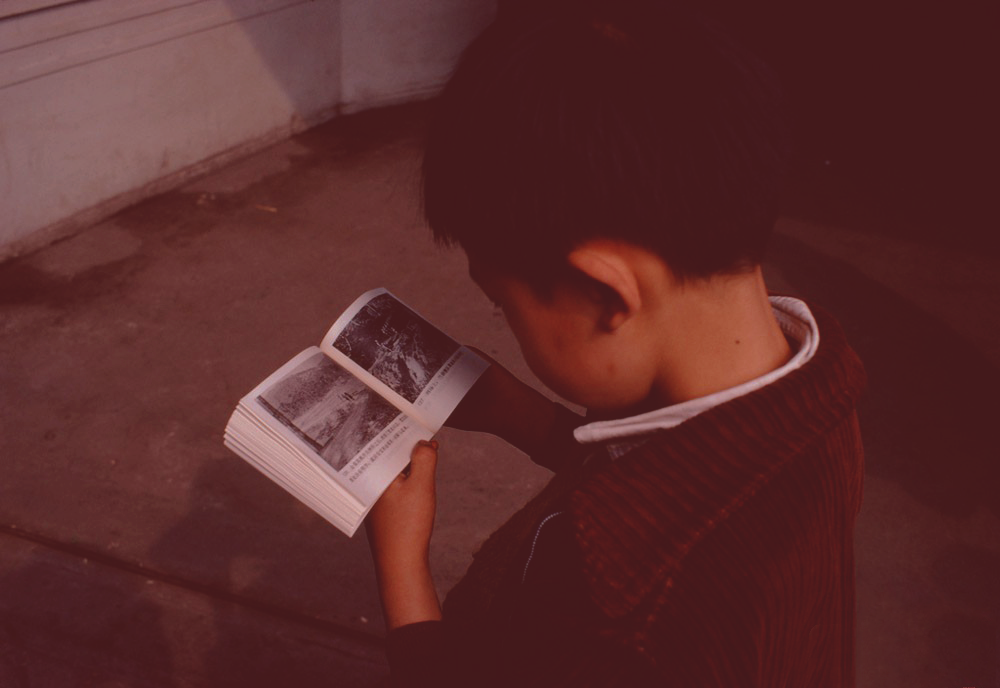
Image source: https://chinareading.wordpress.com/2022/08/10/little-boy-reading-a-comic-book-1980s/
Funding and hosting institutions#

Funded by the European Union (ERC, Grant ID: 101088049).
Views and opinions expressed are however those of the author(s) only and do not necessarily reflect those of the European Union or the European Research Council Executive Agency.

We are located at the Centre for Asian and Transcultural Studies, Institute of Chinese Studies, Heidelberg University.

Affiliated with the Heidelberg University, supporting the ChinaComx project through hosting and academic resources.